Selasa, 11 Desember 2007

Harry Potter Boxset Books 1-7 (Hardcover)


The Harry Potter Boxed Set 1-7 includes all seven Harry Potter hardcover books by bestselling author J.K. Rowling, and is housed in a printed and customizable (decorative stickers included) cardboard box featuring a plastic lock and handles.

You: On A Diet: The Owner's Manual for Waist Management (Hardcover)


Starred Review. Back for another highly entertaining round of Biology 101, the team behind YOU: The Owner's Manual applies its signature wit and wisdom to food metabolism and nutrition. According to Roizen and Oz, waist measurement, not weight, is the most important factor in mortality related to obesity, and understanding the relationship between chemicals and hormones influencing hunger and those signaling satiety is the key to ending yo-yo dieting. Most diets fail, Roizen and Oz conclude, because body chemistry overrules the best plans and intentions. To restore the body's natural ability to balance hunger and satiety and offset the effects of stress on food choices, they list foods and supplements that fight fat, decrease appetite and combat inflammation that causes disease. Roizen and Oz pack in a lot of material—quizzes, "factoids" and "myth busters" along with diet and exercise plans, recipes and a two-week "rebooting" program—in bite-sized portions, giving readers a chance to absorb and apply what they learn. For those considering medical intervention, they discuss current options for drugs and surgery. (Oct.)
Copyright © Reed Business Information, a division of Reed Elsevier Inc. All rights reserved.

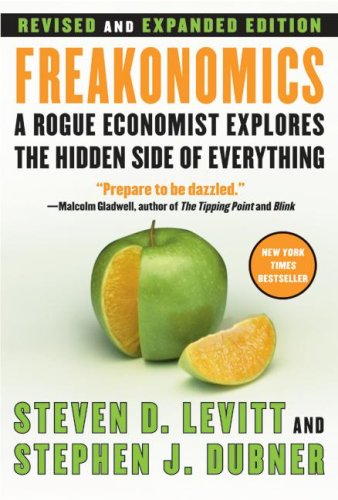
Freakonomics [Revised and Expanded]: A Rogue Economist Explores the Hidden Side of Everything (Hardcover)


Economics is not widely considered to be one of the sexier sciences. The annual Nobel Prize winner in that field never receives as much publicity as his or her compatriots in peace, literature, or physics. But if such slights are based on the notion that economics is dull, or that economists are concerned only with finance itself, Steven D. Levitt will change some minds. In Freakonomics (written with Stephen J. Dubner), Levitt argues that many apparent mysteries of everyday life don't need to be so mysterious: they could be illuminated and made even more fascinating by asking the right questions and drawing connections. For example, Levitt traces the drop in violent crime rates to a drop in violent criminals and, digging further, to the Roe v. Wade decision that preempted the existence of some people who would be born to poverty and hardship. Elsewhere, by analyzing data gathered from inner-city Chicago drug-dealing gangs, Levitt outlines a corporate structure much like McDonald's, where the top bosses make great money while scores of underlings make something below minimum wage. And in a section that may alarm or relieve worried parents, Levitt argues that parenting methods don't really matter much and that a backyard swimming pool is much more dangerous than a gun. These enlightening chapters are separated by effusive passages from Dubner's 2003 profile of Levitt in The New York Times Magazine, which led to the book being written. In a book filled with bold logic, such back-patting veers Freakonomics, however briefly, away from what Levitt actually has to say. Although maybe there's a good economic reason for that too, and we're just not getting it yet. --John Moe --This text refers to the Roughcut edition.

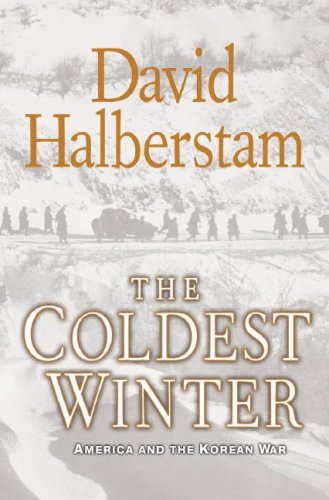
The Coldest Winter: America and the Korean War (Hardcover)


Reviewed by James BradyAt the heart of David Halberstam's massive and powerful new history of the Korean War is a bloody, losing battle fought in November 1950 in the snow-covered mountains of North Korea by outnumbered American GIs and Marines against the Chinese Communist Army.Halberstam's villain is not North Korea's Kim Il Sung or China's Chairman Mao or even the Soviet Union's Josef Stalin, who pulled the strings. It's the legendary general Douglas MacArthur, the aging, arrogant, politically ambitious architect of what the author calls the single greatest American military miscalculation of the war, MacArthur's decision to go all the way to the Yalu [River] because he was sure the Chinese would not come in.Much of the story is familiar. What distinguishes this version by Halberstam (who died this year in a California auto crash) is his reportorial skill, honed in Vietnam in Pulitzer-winning dispatches to the New York Times. His pounding narrative, in which GIs and generals describe their coldest winter, whisks the reader along, even though we know the ending.Most Korean War scholars agree that MacArthur's sprint to the border of great China with a Siberian winter coming on resulted in a lethal nightmare. Though focused on that mountain battle, Halberstam's book covers the entire war, from the sudden dawn attack by Kim Il Sung's Soviet-backed North Koreans against the U.S.-trained South, on June 25, 1950, to its uneasy truce in 1953. It was a smallish war but a big Cold War story: Harry Truman, Stalin and Mao, Joe McCarthy and Eisenhower, George C. Marshall and Omar Bradley, among others, stride through it. A few quibbles: there were no B-17 bombers destroyed on Wake Island the day after Pearl Harbor, as Halberstam asserts, and Halberstam gives his minor characters too much attention.At first MacArthur did well, toughing out those early months when the first GIs sent in from cushy billets in occupied Japan were overwhelmed by Kim's rugged little peasant army. MacArthur's greatest gamble led to a marvelous turning point: the invasion at Inchon in September, when he outflanked the stunned Reds. After Inchon, the general headed north and his luck ran out. His sycophants, intelligence chief Willoughby and field commander Ned Almond, refused to believe battlefield evidence indicating the Chinese Communists had quietly infiltrated North Korea and were lying in wait. The Marines fought their way out as other units disintegrated. In the end, far too late, Truman sacked MacArthur.Alive with the voices of the men who fought, Halberstam's telling is a virtuoso work of history. (Sept.)James Brady, columnist at Parade and Forbes.com, is author of several books about Korea. His latest book is Why Marines Fight (St. Martin's, Nov.).
Copyright © Reed Business Information, a division of Reed Elsevier Inc. All rights reserved.

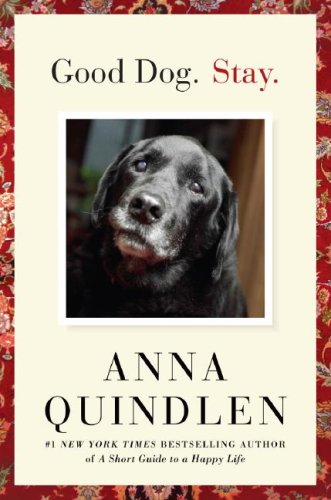
Good Dog. Stay. (Hardcover)


“The life of a good dog is like the life of a good person, only shorter and more compressed,” writes Pulitzer Prize-winning author Anna Quindlen about her beloved black Labrador retriever, Beau. With her trademark wisdom and humor, Quindlen reflects on how her life has unfolded in tandem with Beau’s, and on the lessons she’s learned by watching him: to roll with the punches, to take things as they come, to measure herself not in terms of the past or the future but of the present, to raise her nose in the air from time to time and, at least metaphorically, holler, “I smell bacon!”

Of the dog that once possessed a catcher’s mitt of a mouth, Quindlen reminisces, “there came a time when a scrap thrown in his direction usually bounced unseen off his head. Yet put a pork roast in the oven, and the guy still breathed as audibly as an obscene caller. The eyes and ears may have gone, but the nose was eternal. And the tail. The tail still wagged, albeit at half-staff. When it stops, I thought more than once, then we’ll know.”

Heartening and bittersweet, Good Dog. Stay. honors the life of a cherished and loyal friend and offers us a valuable lesson on our four-legged family members: Sometimes an old dog can teach us new tricks.

Be the Pack Leader: Use Cesar's Way to Transform Your Dog . . . and Your Life (Hardcover)


Bestselling author Cesar Millan takes his principles of dog psychology a step further, showing you how to develop the calm-assertive energy of a successful pack leader and use it to improve your dog’s life–and your own.

Filled with practical tips and techniques as well as real-life success stories from his clients (including the Grogan family, owners of Marley from Marley & Me) and his popular television show Dog Whisperer with Cesar Millan, Cesar helps you understand and read your dog’s energy as well as your own so that you can move beyond just correcting behavioral issues and take your connection with your dog to the next level.

The principles of calm-assertive energy will help you become a better pack leader in every area of your life, improving your relationships with friends, family, and coworkers.

In addition, Cesar addresses several important issues for the first time, including what you need to know about the major dog behavior tools available and the difference between “personality” and “instability.”

Ultimately, what emerges from Be the Pack Leader are both happier dogs and happier, more centered owners.

Animal, Vegetable, Miracle: A Year of Food Life (Hardcover)


Starred Review. [Signature]Reviewed by Nina PlanckMichael Pollan is the crack investigator and graceful narrator of the ecology of local food and the toxic logic of industrial agriculture. Now he has a peer. Novelist Kingsolver recounts a year spent eating home-grown food and, if not that, local. Accomplished gardeners, the Kingsolver clan grow a large garden in southern Appalachia and spend summers "putting food by," as the classic kitchen title goes. They make pickles, chutney and mozzarella; they jar tomatoes, braid garlic and stuff turkey sausage. Nine-year-old Lily runs a heritage poultry business, selling eggs and meat. What they don't raise (lamb, beef, apples) comes from local farms. Come winter, they feast on root crops and canned goods, menus slouching toward asparagus. Along the way, the Kingsolver family, having given up industrial meat years before, abandons its vegetarian ways and discovers the pleasures of conscientious carnivory.This field—local food and sustainable agriculture—is crowded with books in increasingly predictable flavors: the earnest manual, diary of an epicure, the environmental battle cry, the accidental gardener. Animal, Vegetable, Miracle is all of these, and much smarter. Kingsolver takes the genre to a new literary level; a well-paced narrative and the apparent ease of the beautiful prose makes the pages fly. Her tale is both classy and disarming, substantive and entertaining, earnest and funny. Kingsolver is a moralist ("the conspicuous consumption of limited resources has yet to be accepted widely as a spiritual error, or even bad manners"), but more often wry than pious. Another hazard of the genre is snobbery. You won't find it here. Seldom do paeans to heirloom tomatoes (which I grew up selling at farmers' markets) include equal respect for outstanding modern hybrids like Early Girl.Kingsolver has the ear of a journalist and the accuracy of a naturalist. She makes short, neat work of complex topics: what's risky about the vegan diet, why animals belong on ecologically sound farms, why bitterness in lettuce is good. Kingsolver's clue to help greenhorns remember what's in season is the best I've seen. You trace the harvest by botanical development, from buds to fruits to roots. Kingsolver is not the first to note our national "eating disorder" and the injuries industrial agriculture wreaks, yet this practical vision of how we might eat instead is as fresh as just-picked sweet corn. The narrative is peppered with useful sidebars on industrial agriculture and ecology (by husband Steven Hopp) and recipes (by daughter Camille), as if to show that local food—in the growing, buying, cooking, eating and the telling—demands teamwork. (May)Nina Planck is the author of Real Food: What to Eat and Why (Bloomsbury USA, 2006).
Copyright © Reed Business Information, a division of Reed Elsevier Inc. All rights reserved.
Adult/High School–This book chronicles the year that Barbara Kingsolver, along with her husband and two daughters, made a commitment to become locavores–those who eat only locally grown foods. This first entailed a move away from their home in non-food-producing Tuscon to a family farm in Virginia, where they got right down to the business of growing and raising their own food and supporting local farmers. For teens who grew up on supermarket offerings, the notion not only of growing one's own produce but also of harvesting one's own poultry was as foreign as the concept that different foods relate to different seasons. While the volume begins as an environmental treatise–the oil consumption related to transporting foodstuffs around the world is enormous–it ends, as the year ends, in a celebration of the food that physically nourishes even as the recipes and the memories of cooks and gardeners past nourish our hearts and souls. Although the book maintains that eating well is not a class issue, discussions of heirloom breeds and making cheese at home may strike some as high-flown; however, those looking for healthful alternatives to processed foods will find inspiration to seek out farmers' markets and to learn to cook and enjoy seasonal foods. Give this title to budding Martha Stewarts, green-leaning fans of Al Gore's An Inconvenient Truth (Rodale, 2006), and kids outraged by Eric Schlosser's Fast Food Nation (Houghton, 2001).–Jenny Gasset, Orange County Public Library, CA
Copyright © Reed Business Information, a division of Reed Elsevier Inc. All rights reserved.